
Software defined storage: the core driving force of data infrastructure, empowering the new blue ocean of industrial digital transformation
Over the past two decades, the dominant logic in the enterprise storage market has been 'hardware defines everything'. The price of a storage device depends on how many hard drives are installed in the chassis, how much cache capacity is provided, and how many interface protocols are supported. User procurement of storage is essentially purchasing a fixed hardware combination - performance is locked by the controller, capacity is limited by the chassis, management relies on the manufacturer's proprietary interface, and expansion means repeated investment. This logic barely works in the era of linear growth in data volume, but as data splits from structured text into unstructured images, videos, and IoT temporal streams, and business loads expand from steady-state ERP and databases to sensitive containers, big data analysis, and edge inference, the rigid architecture of traditional storage begins to get stuck everywhere.
The birth of software defined storage is precisely to overthrow this hardware hegemony from the bottom. It separates the storage function from dedicated hardware and hands it over to the software layer for unified abstraction, orchestration, and scheduling. The lower layer uses standardized x86 servers or commercial storage media, while the upper layer implements policy driven, automated operation and maintenance, and on-demand supply through the control plane. Users no longer need to pay a premium for a specific brand of controller, nor do they have to endure a 300% hardware price jump for 20% performance growth. Storage has evolved from a device encapsulated in a chassis to a service running in a universal resource pool. This is not only an iteration of technical architecture, but also a complete reset of storage economics.
The industrial value of this reset is first reflected in the fundamental optimization of the cost structure. The procurement cost per TB of effective capacity for traditional enterprise level storage arrays has remained high for a long time, while software defined storage decouples storage software and hardware. Users can choose commercial servers with better cost-effectiveness as the hosting platform and use data reduction algorithms to increase physical storage efficiency by three to five times. IDC data shows that enterprises deploying software defined storage solutions have an average five-year total cost of ownership reduction of over 40% compared to traditional storage. The more covert benefits come from the leap in operational efficiency - traditional storage expansion requires downtime, connectivity, and configuration of LUN mapping, which can take several hours or even cross day windows; Under the resource pooling architecture of software defined storage, administrators can drag and drop configurations on the control interface, and newly added capacity can be included in the online space within minutes, with zero business awareness. This agility has evolved from efficiency advantages to survival needs for Internet businesses that need to deal with traffic peaks, retail systems that fluctuate seasonally, and development and testing environments that iterate frequently.
But the value of software defined storage does not stop at reducing costs and increasing efficiency. It is the core driving force for the transition of data infrastructure from supporting systems to driving systems. When storage resources can be dynamically orchestrated by software policies, the location, flow, protection level, and access frequency of data are no longer fixed attributes of physical devices, but programmable business semantics. Financial institutions can store hot data in high-performance flash storage layers, automatically classify cold data into low-cost object storage, encrypt compliant archived data, and push it to remote cloud platforms; Third tier hospitals save PACS image data in real-time to a software defined storage cluster, with outpatient retrieval response latency controlled within two seconds, while historical data does not require expensive online storage resources; Manufacturing enterprises will write real-time equipment timing data from factories across the country into a software defined storage unified namespace. The headquarters algorithm team can simultaneously train predictive models and monitor production line anomalies on the same data view. Storage is no longer a passive resource pool waiting to be called, but an active node integrated into business processes, responding to business intentions, and driving business decisions.
The digital transformation of industries is entering a deep water zone, characterized by data no longer being the object of collection, storage, and analysis, but rather the constituent elements of the business itself. The autonomous driving road test fleet sends back dozens of TB of video data every day, and each frame of the image may become training material for algorithm iteration; The million level terminals of the smart grid report operating conditions at millisecond frequency, and any data loss in a second means a blind spot in situational awareness; The Internet content platform processes tens of thousands of user requests per second at the peak, and the real-time nature of the recommendation engine directly determines the retention of users. The requirements for storage in these scenarios have long exceeded the simple stacking of capacity and performance. They require storage systems that can be embedded in the application lifecycle in a service-oriented manner, dynamically adjust resource allocation according to business priorities, and complete classification, labeling, and routing while data is generated. This is precisely the core capability domain of software defined storage.
The market's response to this trend is accelerating. The global software defined storage market has maintained a double-digit compound growth rate over the past five years, with the growth rate in the Chinese market significantly higher than the global average. Key industries such as finance, government, telecommunications, healthcare, and manufacturing have all incorporated software defined storage into the standard technology roadmap for infrastructure transformation. A large state-owned bank has realized that over 60% of its production storage is carried by software defined architecture, and the infrastructure cost of its core accounting system has been reduced by one-third at the same service level. A provincial-level government cloud platform uses software defined storage to build a unified data base, supporting the business systems of more than 60 commission offices upwards. The data sharing and exchange latency is compressed from the hour level to the minute level. The practices of these pioneers are accumulating into industry consensus: software definition is not a testing ground for edge businesses, but a deterministic choice for core production systems.
Technological innovation is still accelerating its evolution. The maturity of container storage interface standards enables stateful applications to seamlessly integrate with software defined storage on the Kubernetes platform, filling the last gap in cloud native architecture. New media and protocols such as persistent memory and NVMe over fabrics push the performance boundary of software defined storage to millions of IOPS and sub millisecond latency, which is sufficient to support the highest level of loads such as transaction payments and real-time risk control. Intelligent operation and anomaly prediction algorithms are gradually embedded into the storage control plane. The system can provide early warning of hard disk failures, automatically adjust data distribution, identify access hotspots, and dynamically optimize caching strategies. Storage administrators are liberated from tedious capacity planning, performance tuning, and fault handling, and are now directed towards higher value tasks such as data governance, cost analysis, and architecture design.
However, the popularization of software defined storage still faces implicit cognitive barriers. A considerable number of enterprise decision-makers still view storage as a procurement behavior of "buying hardware", accustomed to using the number of machine heads, cache size, and disk space as selection criteria, lacking trust inertia in software licensing, subscription models, and decoupled architecture business logic. Some industry users are trapped by historical investments, and existing storage assets have not been fully depreciated. Building a new software defined storage cluster means dual stack parallelism and skill restructuring, which poses short-term resistance. The maturity of the service ecosystem also needs to be improved - traditional storage vendors have trained a large number of engineers familiar with dedicated operating systems and command-line interfaces, while software defined storage requires a new generation of infrastructure talents who understand the principles of distributed systems, master automated operation and maintenance tools, and can write strategy scripts. From device procurement to service subscription, from hardware operation and maintenance to software definition, from closed systems to open source ecosystems, this cognitive migration has just begun.
Looking ahead, the evolution of software defined storage will follow three parallel main lines. One is the continuous approximation of performance and reliability - as underlying technologies such as DPU, in memory computing, and lossless networks mature, software defined storage is expected to achieve service level agreements for dedicated devices on general hardware platforms. The second is the deep integration of data management and storage - the storage system will have built-in richer data compression, encryption, deduplication, and orchestration capabilities, and data does not need to be relocated back and forth between external analysis platforms and storage clusters. The third is the popularization of ecological service forms - software defined storage will coexist with multiple delivery modes such as cloud market mirrors, hosting services, and all-in-one machines, adapting to the diverse needs of cloud service providers from ultra large scale to edge branch offices.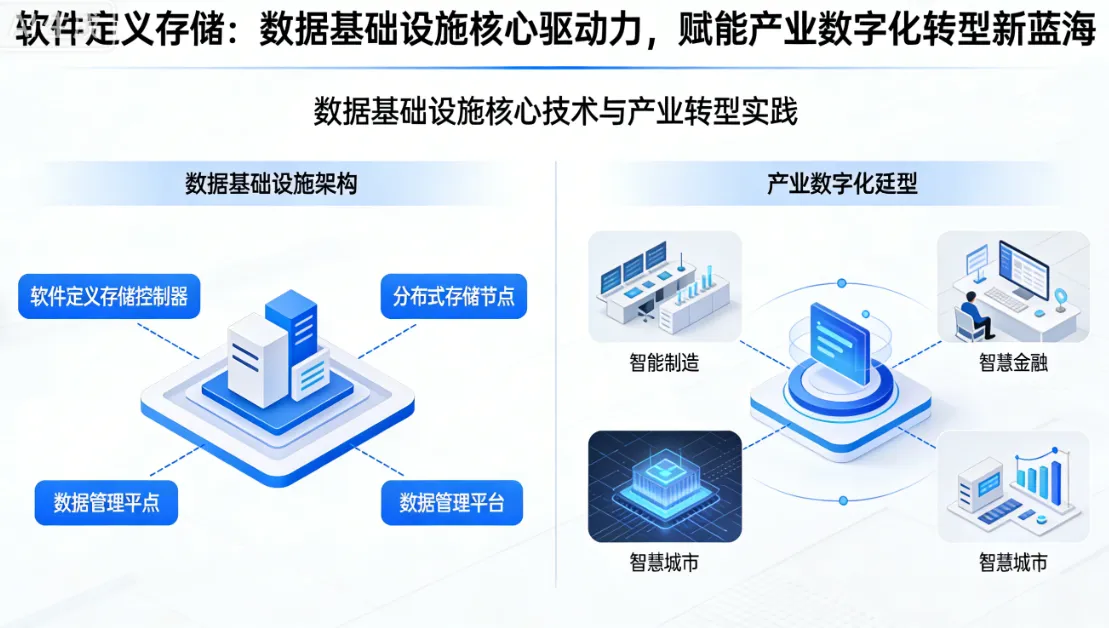
Storage is the most fundamental medium for human-computer interaction and also the most silent infrastructure in the digital world. When software definition liberates storage from the hardware cage, data gains true freedom. This freedom will not directly appear in the subjects of financial statements, nor in the demonstration stage of product launches, but it will permeate into every online transaction that responds in seconds, every immersive video rendered in real-time, and every personalized recommendation that is accurately reached. Software defined storage is not the name of a new technology, but a triumph of an infrastructure philosophy - it believes that software is closer to business than hardware, that abstraction is more dynamic than solidification, and that openness is more in line with the evolutionary logic of the digital age than lock-in. In this sense, software defined storage is not only a new blue ocean in the market definition, but also a necessary passage to the deep waters of industrial digitization.