
How is the development of footwear ERP in various provinces? In depth analysis of the four major industry tiers
Footwear is a typical clustered and labor-intensive industry. Footwear ERP is different from general manufacturing ERP, requiring adaptation to industry specific scenarios such as cutting, needle sewing, molding, sizing and color matching, outsourcing processing, and piece rate accounting. It is divided into two categories: vertical production ERP for factories and distribution ERP for brand channels. From a national perspective, the popularization depth, application level, and service provider resources of footwear ERP are highly dependent on the footwear industry belt, showing obvious gradient regional characteristics: mature coastal production areas have moved from "online ERP" to multi system collaboration and deepening, while the central and western regions have formed incremental markets by relying on production capacity transfer, and scattered production areas have weak digital foundations. At the same time, there are significant differences in industrial structure, customer demand, and ecological support among different regions, presenting both opportunities and risks.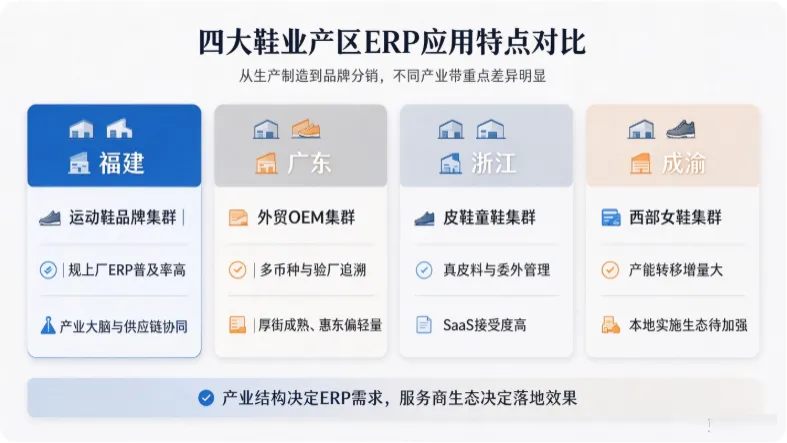
1、 Regional echelon pattern: from mature highland to starting blue ocean
Based on the degree of industrial agglomeration, ERP penetration rate, and depth of digital implementation, the domestic footwear ERP market can be divided into four major tiers.
The first tier consists of Fujian, Guangdong, and Zhejiang, which are mature highlands for digitalization in the domestic footwear industry. Fujian is centered around Jinjiang, Shishi, and Putian, with a complete chain of sports shoe brands and supporting OEM industries. The ERP penetration rate of local shoe factories is high, and top brands such as ANTA and Xtep have generally established an ERP+PLM+MES+SCM integrated system to achieve multi factory and multi supplier collaboration; Vertical industry service providers such as Yuantian and Weichuang, as well as a large number of localized implementation consultants, gather together. In addition, local digital subsidies and continuous promotion of industrial brain projects provide ample sample cases. However, there is a prominent polarization within the region, with a large number of shoe uppers and small and micro workshops still relying on Excel manual management; Due to data concerns, the willingness to invest in information technology in Putian's foreign trade individual factories is relatively conservative. Guangdong, with Dongguan Houjie, Huidong, and Heshan as its core areas, is the national core area for foreign trade outsourcing. The factory ERP focuses on meeting foreign trade scenarios such as multi currency settlement, customer supply management, customs declaration documents, and overseas customer factory inspection traceability. Manufacturers such as Yuantian have mature experience in landing in South China. The digitalization level of large OEM enterprises in Houjie is comparable to that of Jinjiang, while Huidong women's shoes are mainly small and micro couple factories, mostly using low-priced SaaS for inventory and sales. The penetration rate of complete production ERP is low, coupled with fluctuations in foreign trade orders and pressure from industry relocation, resulting in weak stability of information technology budget. Zhejiang focuses on Lucheng, Rui'an, and Wenling in Wenzhou, specializing in genuine leather shoes, children's shoes, and domestic brands. Established leather shoe companies such as Kangnai and Red Dragonfly started digitalization earlier, and local service providers are deeply involved in leather shoe characteristic scenarios such as material loss accounting, multi-layer outsourcing, and piece rate wages; Wenling children's shoes have a wide variety of styles and small order quantities, and have a high acceptance of cloud SaaS ERP. The shortcomings lie in the insufficient digital awareness of a large number of elderly workshop owners, the high complexity of managing non-standard genuine leather materials, and the insufficient supply of local composite consultants with both shoe-making technology and ERP implementation capabilities.
The second tier includes Chongqing, Sichuan, Shandong, and Jiangsu, which are rapidly growing incremental markets. As the shoe capitals of western China, Wuhou in Chengdu, Sichuan and Bishan in Chongqing undertake the transfer of women's shoe production capacity along the coast. New factories are synchronously planned with ERP during the production stage, and local parks are equipped with digital support policies. However, there is a lack of a resident professional footwear ERP implementation team locally, and most rely on coastal agents for remote delivery, resulting in slow after-sales response and higher risk of project launch failure; Enterprises mainly rely on OEM manufacturing, with few independent brands and limited internal driving force for digital transformation. Shandong Gaomi and Qingdao, as well as Jiangsu Taizhou and Kunshan, are mainly engaged in the production of labor protection shoes, workwear shoes, and shoe materials. They have stable orders and simple styles, but do not have strong demand for complex cutting process modules. Many enterprises directly transform on the basis of UFIDA and Kingdee general ERP. The market space for vertical shoe industry specific ERP is limited, and local service providers are mostly general software agents, lacking experience in shoe industry technology implementation.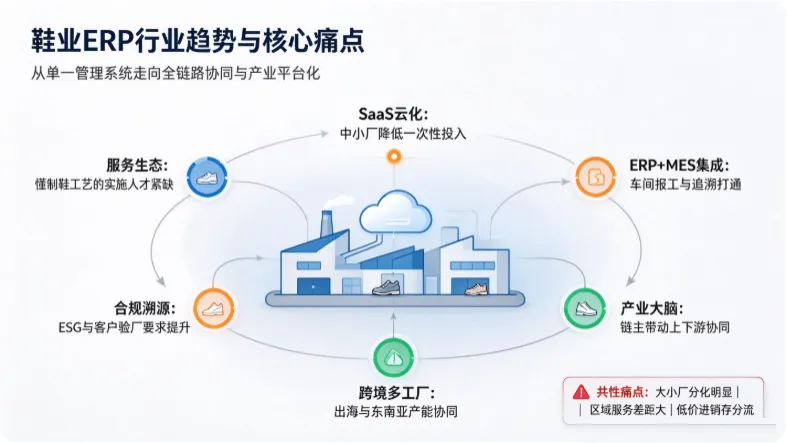
The third tier consists of emerging industrial parks in Henan and Hebei provinces, with representative regions including Suixian and Yanshi in Henan and Suning in Hebei, belonging to the blue ocean market starting from digitalization. Relying on the advantages of land and labor costs, a large amount of coastal production capacity continues to shift here. The construction of standardized factories has the advantage of being a latecomer, without the historical burden of outdated systems, and can directly go online with cloud native ERP; Local governments provide subsidies for digital pilot projects to attract investment, and leading chain enterprises have the opportunity to drive upstream and downstream supporting factories to integrate into the system. But the shortcomings are also prominent: the supporting industrial chain is not perfect, the digital foundation of subcontracting factories is weak, the management team has insufficient understanding of BOM, process reporting, and fine cost accounting, and there is no professional industry consultant locally, relying entirely on remote teams for implementation, with high delivery risks. Enterprises are prone to equating ERP with accounting software, which can lead to acceptance disputes.
The fourth tier consists of scattered production areas such as Hunan, Hubei, Guangxi, Jiangxi, etc. There are no contiguous shoe-making clusters, only a small number of relocated small processing factories, most of which are only responsible for a single processing link and rarely deploy complete production ERP. They generally use simple inventory or manual ledger. The market size is small, customers are scattered, and service providers find it difficult to operate on site for a long time. They mainly rely on remote SaaS services, resulting in short customer retention periods and high renewal risks.
2、 Comprehensive SWOT analysis of each region
(1) First tier (Fujian, Guangdong, Zhejiang)
Advantages: complete industrial chain, rich model projects, intensive industry service providers and implementation talents, and continuous support from government digital policies; The expansion of top brands overseas and the layout of Southeast Asian factories have stimulated the demand for cross-border multi organizational collaboration, and new demands such as foreign trade factory inspection and ESG traceability continue to open up value-added space. Disadvantage: The digital divide between large and small factories is huge, and the informationization of small and micro supporting workshops is stagnant; There are many outdated C/S systems in stock, severe data silos in heterogeneous systems, and the traditional ERP flexible adaptation pressure is high under the small order fast response mode, resulting in high customization and development costs. Opportunity: Industrial brain and supply chain collaboration platform promote unified digitalization of upstream and downstream supporting enterprises; The continuous price reduction of lightweight SaaS products has leveraged the long tail small and micro factory market; Expand the value-added module of ERP to meet compliance requirements such as carbon footprint and material traceability. Threat: Top brands develop their own internal systems, reducing the share of external procurement and commercial ERP; General ERP vendors continue to sink and compete for medium-sized customers; Orders continue to migrate to Southeast Asia, and the scale of new domestic projects shrinks; Small and medium-sized shoe enterprises are facing profit pressure and have strict requirements for digital investment return.
(2) Second tier (Chengdu Chongqing, Shandong Suzhou)
The advantage of the Chengdu Chongqing region lies in its fast incremental growth rate, centralized industrial parks that facilitate the packaging of digital projects, with a focus on domestic sales orders, simple business processes, and adaptability to lightweight cloud ERP. The disadvantages are weak localization implementation ecology, unstable delivery quality, incomplete supporting industrial chain, and difficulty in implementing supply chain collaboration modules. The opportunity lies in following the leading coastal factories to replicate the digital system, importing the system in bulk through a unified platform in the park, and driving the demand for informationization of small women's shoes through live streaming e-commerce. The threat is the continued transfer of production capacity to lower cost regions, unstable customer retention, and vicious competition from low-priced inventory software that compresses vertical ERP profits. The advantages of the Lu Su labor protection shoe production area are stable orders, simple BOM, low implementation threshold, a large number of enterprises already have a universal ERP foundation, and low transformation and migration costs. The disadvantage is that the industry is scattered, the vertical footwear ERP market has a small capacity, and service providers have a low willingness to invest. The opportunity comes from the upgrading of safety production and quality inspection ledger regulations, which forces enterprises to improve their traceability modules. The threat lies in the simplicity of the business, where Excel and simple inventory management are sufficient for basic management, leaving the enterprise lacking the motivation to upgrade.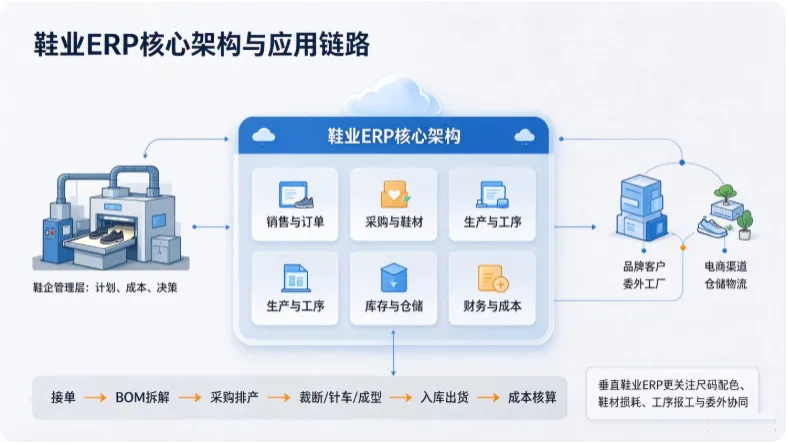
(3) Third tier (Henan, Hebei)
The advantage is that new factories have no historical system burden, land and labor costs attract continuous inflow of production capacity, local investment promotion is supported by digital subsidies, and it is suitable for promoting cloud SaaS models. The disadvantages are weak digital awareness of enterprises, incomplete supporting industrial chains, lack of local process consultants, and high risks of remote project implementation. The opportunity lies in the chain owner enterprise driving the digitalization of cluster collaboration, deploying cloud ERP in one step, and avoiding the transformation of old systems. The threat is that the order liquidity is strong and it is easy to transfer it outward again; The boss prioritizes production over management, resulting in misplaced project expectations and potential disputes.
(4) Fourth tier (scattered production areas such as Hunan, Hubei, Guangxi, and Jiangxi)
The advantage is that the regional competition is small, and a small number of relocated factories come with mature ERP usage experience, which can directly replicate the original solution and is suitable for pure remote SaaS delivery. The disadvantage is that the industry is not scalable, customers are scarce, and most of them are only in a single processing stage, without the need for a complete set of production ERP and lacking local service support. The opportunity is aimed at a small number of e-commerce boutique small factories, promoting lightweight inventory and simple production modules. The threat is that the total number of customers is too small, making it difficult for service providers to sustain operations; The factory has a small scale, short survival period, and poor renewal stability.
3、 National level common trends and industry pain points
Overall, the footwear ERP industry is undergoing several deterministic changes. Firstly, the deployment mode differentiation accelerates the SaaS transformation of small and medium-sized factories, and cloud ERP reduces the threshold for one-time investment; However, top foreign trade giants still prefer private deployment due to data security concerns. Secondly, the positioning of ERP has shifted, no longer being an independent order inventory system. Mature coastal production areas are generally moving towards ERP integration with PLM, MES, and WMS, achieving full chain connectivity of research and development, workshop production, warehousing, and channels; Most factories in the Midwest still rely solely on ERP to manage orders and inventory, with manual workshop processes. Thirdly, the rise of industrial collaboration platforms has led to the creation of industrial brains by governments or chain owners in Fujian, Wenzhou, and other regions, connecting data from upstream and downstream shoe material factories and processing plants, promoting supply chain collaboration, and belonging to the advanced form of industry digitization.
The common pain point across the entire industry is that the gap in regional service ecosystems is far greater than the gap in software products themselves. With the same ERP software, a large number of implementation consultants who understand cutting and sewing processes can be found in Jinjiang and Houjie; In inland production areas, the scarcity of talents familiar with the shoe-making process is the core reason for many project failures. At the same time, industry differentiation continues to widen, and within the same industrial belt, large-scale enterprises have matured in digitalization, while surrounding small workshops have stagnated in digitalization. The regional average level cannot represent the status of all enterprises. General inventory and low-priced simple software continue to divert low-end customers, and the pressure on vertical shoe ERP manufacturers to acquire customers continues to increase.
4、 Summary and Prospect
The development pattern of ERP in the domestic footwear industry is essentially a projection of the gradient transfer of the footwear industry in the digital field. As the first tier, the development mainline of Fujian, Guangdong, and Zhejiang is to deepen collaboration, connect the entire chain, and respond to the needs of going global, small order fast response, and compliance traceability; The core contradiction of Chengdu, Chongqing, Shandong, and Jiangsu relying on capacity transfer to undertake incremental growth is to fill the gaps in local implementation services; Emerging production areas such as Henan and Hebei are in the stage of digital enlightenment, with opportunities concentrated in park empowerment and SaaS lightweight solutions; The market space in other scattered production areas is limited, and remote lightweight services are the main focus.
In the coming period, the domestic footwear ERP market will continue to present a pattern of "deepening along the coast and expanding inland". For software service providers, competition in coastal markets is moving towards integrated solutions, while competition in inland markets is competing for delivery capabilities and localized service construction; For shoe companies, different production areas should rationally choose vertical production ERP, distribution ERP, or lightweight inventory management based on their own order types and industrial chain supporting conditions, to avoid blindly entering the system. At the same time, the cross-border multi factory management, ESG compliance, and e-commerce order collaboration brought about by industrial relocation will become the long-term driving force for the continuous iteration of footwear ERP.