
Analysis of the Development Status and Future Trends of ERP for Small and Medium sized Shoes and Clothing
With the deep integration of the digital economy and the real economy, digital transformation has become the core driving force for the transformation and upgrading of the footwear and apparel industry. The footwear and apparel industry has typical characteristics such as a wide variety of SKUs, complex color code and size systems, fast seasonal iteration, strong demand for quick response to small orders, fragmented online and offline channels, and widespread outsourcing processing modes. General management software is difficult to adapt to personalized business scenarios in the industry, and vertical footwear and apparel ERP has become the core carrier of industry digitization. Compared to the mid platform and full chain intelligent layout of large shoe and clothing brands, small and medium-sized shoe and clothing enterprises are limited by factors such as budget, personnel information literacy, and business volume. ERP construction cannot simply copy the development model of large enterprises that focus on heavy assets and full functionality. Based on the current development status of the industry, exploring a lightweight, practical, and progressive ERP development path that is suitable for small and medium-sized enterprises is the key to reducing costs, increasing efficiency, and breaking through development bottlenecks for small and medium-sized shoe and clothing enterprises.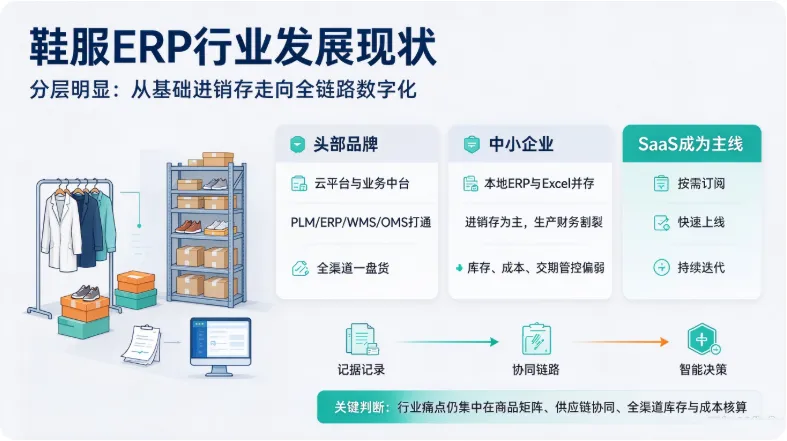
1、 The current overall development status of the footwear and apparel ERP industry
The current domestic footwear and apparel ERP market has formed a clear hierarchical pattern. Leading large brand enterprises have completed the construction of cloud platforms, business platforms, and full chain digital systems, realizing the full integration of PLM research and development, MES production, WMS warehousing, OMS orders, and online and offline retail, driving product planning, inventory allocation, supply chain collaboration, and intelligent decision-making with data. However, small and medium-sized footwear and apparel enterprises, processing plants, regional distributors, and niche brands that dominate the industry are still in the early stages of digital construction, and the industry's development shows a clear polarization feature.
Most small and medium-sized shoe and clothing enterprises still face common digital pain points. Most enterprises rely solely on traditional local ERP to achieve basic inventory management and financial accounting functions. Business such as research and development sampling, material procurement, outsourcing processing, production follow-up, and omni channel sales are separated from each other, forming serious data silos. A large amount of business data relies on manual Excel statistics and supplementation, which is inefficient and has a high error rate. At the same time, the inventory chaos, order conflicts, cumbersome return and exchange processes brought about by multi-channel operations, as well as the complex cost accounting difficulties in the footwear and apparel industry, have led to the inability of enterprises to accurately control the profitability of individual products. Problems such as inventory backlog, delivery delays, and unclear profits have long constrained the development of enterprises.
From the perspective of industry technological iteration, footwear and apparel ERP has fully embarked on cloud transformation, gradually replacing traditional local deployment models. SaaS cloud ERP has become the mainstream choice in the market due to its advantages of low cost, easy operation and maintenance, and flexible iteration. At the same time, new technologies and functions such as AI intelligent decision-making, omni channel inventory, supply chain collaboration, and lightweight business finance integration continue to be implemented, promoting the transformation of shoe and clothing ERP from a simple "document recording tool" to a "business decision-making empowerment platform", providing a new technological foundation and development direction for digital upgrading of small and medium-sized enterprises.
2、 The overall core development trend of the footwear and apparel ERP industry
(1) Intelligent upgrade: shift from post recording to pre prediction and intelligent empowerment
Traditional shoe and clothing ERP only undertakes the basic functions of data entry and post statistics, and cannot adapt to the rapidly changing market demands. In the new era, shoe and clothing ERP is fully embedded with lightweight AI technology, permeating the entire business process and achieving digital value upgrading. On the product side, market hotspots, consumer data, and seasonal trends can be combined to assist in predicting popular products and sales volume; On the inventory side, implement unsold warning, intelligent replenishment, and cross warehouse transfer to effectively reduce inventory backlog; On the production end, adapt to small batch, multi batch, and fast response production modes to achieve material completeness warning and delivery deadline reminder; On the risk control end, it can automatically identify abnormal orders, assess supplier risks, and comprehensively enhance the enterprise's management and control capabilities.
(2) Full link connectivity: PLM and ERP integration, omnichannel integration as standard
The industry is gradually breaking down the business barriers of research and development, production, sales, and retail. The deep integration of PLM product lifecycle management and ERP has become the mainstream trend, achieving full lifecycle management of style design, sampling process, material parameters, cost data, bulk production, terminal sales, and product delisting, completely solving the problems of data duplication and disconnection between research and development and production. At the same time, the overall channel localization layout continues to be implemented, with ERP as the core business base, seamlessly integrating with multi-channel scenarios such as e-commerce, live streaming, mini programs, and offline stores, achieving global inventory sharing, intelligent order allocation, unified return and exchange management, and solving industry pain points such as online and offline channel conflicts and inventory chaos.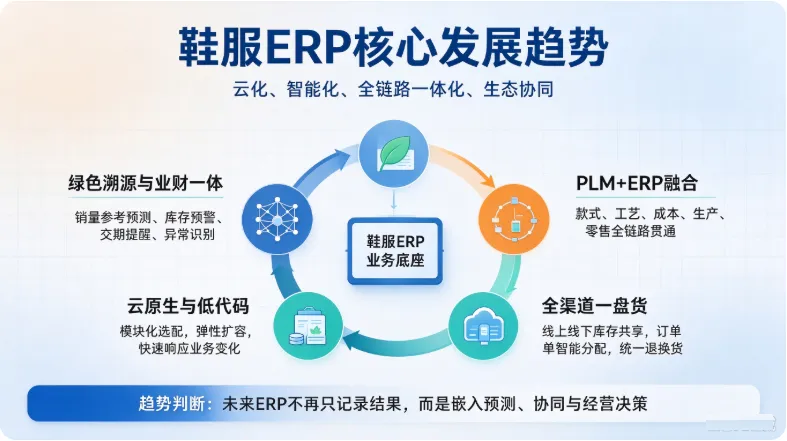
(3) Technological ecosystem iteration: diversified development of cloud native, low code, and green traceability
The cloud native modular framework is the mainstream form of ERP, which can adapt to the personalized needs of enterprises of different sizes, support on-demand function selection and flexible expansion. The integration of low code technology significantly reduces the cost of secondary system development, allowing enterprises to independently adjust business processes, document fields, and statistical reports to adapt to the flexible and ever-changing business models of the footwear and apparel industry. At the same time, with the standardization of overseas trade and the development requirements of domestic ESG, functions such as carbon footprint accounting, fabric traceability, and green supply chain management are gradually integrated into shoe and clothing ERP, becoming essential capabilities for export-oriented shoe and clothing enterprises. In addition, the lightweight integration of IoT devices, machine vision, and ERP enables automatic collection and feedback of production hours, output, and quality inspection data, promoting transparent control of the production process.
(4) Value deepening: Real time and refined control achieved through the integration of business and finance
In response to the complex cost structure of fabrics, accessories, processing, logistics, platform commissions, and return losses in the footwear and apparel industry, the new generation of footwear and apparel ERP has achieved full dimensional automatic cost collection and allocation, breaking the traditional lag mode of manual accounting at the end of the month. It can accurately calculate the real gross profit of individual products and orders in real time, providing data support for product price adjustment, band operation, and order selection, and promoting the shift of enterprise financial management from post accounting to pre control and in-process optimization.
3、 The core development direction of ERP adapted to small and medium-sized shoe and clothing enterprises
Small and medium-sized shoe and clothing enterprises are different from large brand enterprises in that they do not need to pursue a "big and comprehensive" system. The core development logic isLightweight implementation, priority for urgent needs, gradual progress, low-cost efficiency improvementAbandoning heavy, high cost, and high threshold digital solutions, focusing on our own business pain points, and embarking on a refined digital transformation path that is suitable for small and medium-sized enterprises.
(1) Deployment mode: SaaS cloud native as the main approach, modular and iterative as needed
Small and medium-sized shoe and clothing enterprises will completely abandon the traditional local deployment model and focus on SaaS cloud ERP as the core selection and development direction. This model does not require self built servers or professional operation and maintenance teams. The service provider is responsible for system upgrades, data backup, and security maintenance. It adopts an on-demand subscription payment model, which significantly reduces upfront investment and later operation and maintenance costs, perfectly adapting to the limited budget of small and medium-sized enterprises. At the same time, the system adopts a modular split design, so that enterprises do not need to launch all functions at once. They can follow the principle of "first meeting urgent needs, then upgrading", and prioritize the implementation of core modules such as inventory management, order management, and inventory management to solve core operational pain points; After the expansion of the business scale, gradually open up modules such as production order tracking, outsourcing management, business finance integration, and omni channel docking to achieve small steps and gradual digitization, avoiding system implementation failures caused by functional redundancy and excessive workload of employees.
(2) Functional positioning: Focusing on industry needs, simplifying redundant and complex scenarios
Small and medium-sized enterprise ERP will continue to deepen the vertical demand capability of footwear and clothing, retain the core differentiated functions of the industry, and weaken the heavy and complex modules of large enterprises. On the one hand, we deeply cultivate core capabilities such as three-dimensional SKU matrix management of exclusive styles, colors, and codes for shoes and clothing, new bands, BOM accounting for materials and accessories, and simple process sheet management, which are core advantages that cannot be replaced by general ERP; On the other hand, redundant functions such as complex 3D research and development, full process PLM, heavy-duty production middleware, and multi-level cost sharing are abandoned, and lightweight functions are used to meet the daily operational needs of small and medium-sized enterprises.
At the same time, the focus is on adapting to the mainstream small order quick response and outsourcing processing modes of small and medium-sized shoe and clothing enterprises, strengthening functions such as outsourcing material requisition, return verification, process progress tracking, and material completeness warning. There is no need to deploy expensive MES systems, and production progress transparency can be achieved through simple scanning of work orders. On the channel side, build a lightweight omni channel system, connect mainstream e-commerce and live broadcast scenarios such as Tiktok, Taobao, and applet at a low cost, realize basic order synchronization, inventory sharing, and return and replacement management, and solve multi-channel business pain points with a minimalist solution.
(3) Technical application: Light intelligence, low threshold, rejecting technology stacking
The core of the technological development of ERP for small and medium-sized enterprises is "practical implementation", eliminating the accumulation of high-end technologies. AI applications focus on lightweight and essential scenarios, mainly implementing basic functions such as automatic document OCR input, inventory unsold warning, delivery reminder, and simple sales reference prediction, without the need for complex intelligent planning, global data prediction, and other high threshold modules. By relying on low code and no code technology, enterprises can independently fine tune business processes, customize report fields, adapt to changing business scenarios such as order taking, production, quality inspection, and outsourcing, significantly reducing secondary development costs and cycles.
At the level of digitalization in production, we do not blindly deploy a complete set of intelligent hanging and high-end IoT devices. Instead, we use lightweight equipment such as PDA scanning, barcode inventory, and simple labor hour collection to automatically collect basic data for warehousing and production, reducing manual input errors. After the enterprise scale is upgraded, we will gradually integrate with high-end systems such as MES and intelligent warehousing to achieve smooth iteration.
(4) Ecological synergy: Lightweight upstream and downstream linkage, open compatibility and adaptation
In the future, ERP for small and medium-sized enterprises will break the boundaries of internal management within a single enterprise and upgrade to a lightweight supply chain collaboration platform. The system supports opening simple collaborative accounts for fabric suppliers and outsourced processing plants, enabling online circulation of order issuance, progress feedback, material docking, and document verification, replacing the inefficient communication mode of traditional WeChat, phone, and Excel, and solving the pain points of chaotic supply chain collaboration, difficult follow-up, and difficult reconciliation for small and medium-sized enterprises. At the same time, building an open and compatible ecosystem, through standardized API interfaces, low-cost integration with third-party tools such as electronic invoices, logistics systems, e-commerce platforms, office software, etc., to achieve data interoperability among multiple systems, avoid data silos, and adapt to the flexible business models of small and medium-sized enterprises.
(5) Landing operation: minimalist operation, lightweight governance, short cycle landing
In response to the pain points of low information literacy and weak execution ability among employees in small and medium-sized enterprises, ERP will continue to upgrade towards extremely user-friendly direction in the future, simplifying the system operation interface. Frontline warehouse management, order tracking, and sales personnel will only retain core operation permissions, replacing tedious manual operations with mobile scanning and one click input, greatly reducing the threshold for use. At the implementation level, abandoning the implementation cycle of large ERP systems that take more than six months, and controlling the ERP implementation cycle for small and medium-sized enterprises within 1-3 months, to quickly achieve the digital implementation of core business, optimizing while using.
In terms of data governance, we adhere to the principle of lightweight, prioritizing the unification of core master data such as model number, color code, size, and supplier to ensure the accuracy of basic data. Through the system's built-in visual reports, we can quickly achieve statistical analysis of core data such as inventory, sales, and gross profit, without the need to build expensive data warehouses, and achieve data empowered operations at the lowest cost.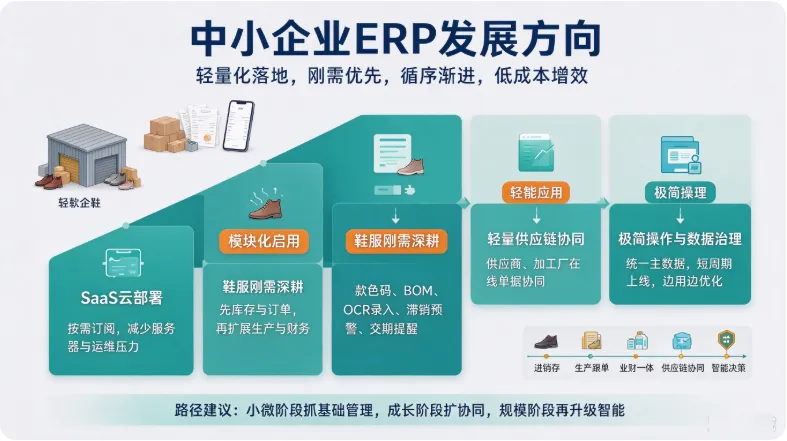
4、 Summary
Overall, the domestic footwear and apparel ERP industry is moving towards a new stage of cloudification, intelligence, full chain integration, and ecological collaboration, upgrading from traditional management tools to the core foundation of enterprise digital management. For the vast majority of small and medium-sized footwear and apparel enterprises in the industry, their ERP development will not replicate the path of large enterprises that focus on heavy assets, full functionality, and high customization, but rather form aLightweight, modular, low-cost, strongly adaptable, progressiveThe exclusive development system. In the future, small and medium-sized shoe and clothing ERP will continue to focus on industry needs, simplify operational thresholds, and reduce transformation costs. With digital solutions that are light in intelligence, light in collaboration, and light in governance, it will help small and medium-sized enterprises solve inventory, production, channel, and cost control problems, achieve refined and efficient operations, and help small and medium-sized shoe and clothing enterprises steadily enhance their core competitiveness in industry transformation and upgrading.