
Precise breakthrough of pain points in the garment industry, full guide to building an ERP system for garment manufacturing
In the clothing and garment industry, the characteristics of multiple styles, colors, and sizes, combined with the collaborative needs of design, procurement, production, and sales, make it difficult for traditional manual management models to cope with core pain points such as delivery pressure, cost control, and inventory chaos. A clothing and garment ERP system that meets industry needs has become the key to achieving digital transformation and enhancing core competitiveness for enterprises. Unlike general ERP systems, clothing and garment ERP needs to deeply adapt to the entire industry process, focusing on the four core elements of "BOM+process+barcode/scanning+dynamic cost". From demand planning to implementation and operation, every step requires precise layout. This article combines industry characteristics to provide a detailed breakdown of the logic and practical steps for building a clothing ERP system, in order to assist enterprises in efficiently implementing digital management.
1、 Pre planning: Anchoring demand to avoid "not adapting to the local conditions"
The core prerequisite for building an ERP system for clothing and garment manufacturing is to first clarify the company's own processes and core pain points, and avoid blind deployment that may lead to a disconnect between the system and the business. The core goal of this step is to produce a 'Requirements Specification' that is tailored to the actual needs of the enterprise, laying the foundation for subsequent system design and implementation.
Firstly, it is necessary to sort out the typical entire process of the garment industry and clarify each key node from receiving orders to receiving payments: after the order/plan is initiated, it enters design sampling, BOM and process sheet preparation, material procurement, acceptance and warehousing, production scheduling, cutting, sewing, finishing, finished product warehousing, shipping, and reconciliation and payment. Each link is interrelated, and any disconnection in any link may affect delivery time and cost.
Secondly, it is necessary to accurately capture industry-specific pain points, which is also the core difference between clothing ERP and general ERP. Clothing companies generally face five major pain points: firstly, there are numerous styles, colors, sizes, and batches, making inventory counting and traceability difficult; Secondly, the loss rate of raw materials is high, and replenishment is frequent, making it difficult to control costs; Thirdly, the production process is complex, from cutting and sewing to ironing and packaging, and the calculation of piece rate wages is cumbersome and prone to errors; The fourth issue is the tight delivery schedule and frequent insertion of orders, making it difficult to track production progress in real-time; Fifth, the cost structure is complex, and it is difficult to accurately collect materials such as fabrics, labor costs, auxiliary materials, and losses, resulting in fuzzy profit accounting.
Finally, a project team consisting of multiple departments including IT, design, production, procurement, warehouse management, finance, and sales will be formed to jointly review the organizational structure, job permissions, and existing processes of the enterprise, clarify pain point lists, report requirements, and external systems that need to be integrated (such as WMS warehouse management system, MES production execution system, e-commerce platform, etc.), and ultimately form a complete "Requirements Specification" as the core basis for system construction.
2、 Core module design: tailored to the industry, covering full chain collaboration
The core value of the clothing and garment ERP system lies in achieving seamless collaboration among the seven major modules of "research and development → supply chain → production → inventory → sales → finance → decision-making". Each module needs to be tailored to the characteristics of the clothing industry and solve practical business pain points, rather than simply applying generic modules.
(1) Design and R&D management: Control the source and lay the cost foundation
Design and research and development are the source of garment production and a key link in cost control. This module needs to implement styles BOM、 Digital management of the entire process of craftsmanship and sampling: Establish a complete style file, clarify the style number, name, season, band, image, and color/size chart, and achieve centralized management of style information; Refined BOM management, detailed recording of fabric (composition, weight, color code, cylinder number), auxiliary materials (zipper, button, ribbon, etc.) usage and loss rate, providing accurate data for subsequent procurement and cost accounting; Prepare standardized process sheets, clarify process routes, standard working hours, labor prices, required equipment, and production precautions, and standardize production processes; Track the entire sampling process, manage sampling orders, sample clothing storage and lending, accurately calculate sampling costs, and avoid ineffective losses.
(2) Procurement and Supply Chain Management: Ensuring Materials and Reducing Procurement Costs
The procurement of materials and accessories is a prerequisite for garment production, and this module needs to achieve full process control of suppliers, procurement, quality inspection, and reconciliation. Establish supplier files to record quotes, delivery dates, credit ratings, and other information of materials and outsourcing suppliers, in order to facilitate the screening of high-quality suppliers; Based on the BOM list and existing inventory, automatically calculate material requirements, generate purchase requests and purchase orders, and avoid excessive procurement or material shortages; Strictly implement incoming material quality inspection, with a focus on testing fabric weight, color fastness, width, and accessory specifications. Timely handle returns or concession acceptance of non-conforming materials to ensure the quality of production raw materials; Implement supplier reconciliation automation, accurately reconcile accounts with delivery notes and quality inspection forms, and reduce reconciliation errors.
(3) Production management: Focus on the core and improve production efficiency
Production management is the core module of clothing ERP, which needs to address core pain points such as production scheduling, process flow, progress tracking, and piece rate wage accounting. Manage sales orders, production work orders, and outsourcing work orders to achieve precise integration between orders and production; Intelligent production scheduling based on delivery time, production capacity, and material availability, supporting order insertion adjustments to avoid production chaos; Scan the QR code to report work through a mobile app or PDA, and record the process, output, working hours, and defective product situation in real time, achieving digitalization of workshop work reporting; Refine the management of the cutting process, covering the entire process of layout, drawing, cutting, tying, and slicing, to reduce fabric loss; Track the flow of sewing, finishing and other processes, automatically calculate piece rate wages, and standardize rework management; Through the production dashboard, real-time display of production progress, capacity, defect rate, and delivery warning, making the production situation clear at a glance.
(4) Inventory and warehouse management: precise control to reduce inventory backlog
In response to the demand for multidimensional inventory management in the garment industry, this module needs to achieve refined and traceable inventory management. Support multi-dimensional inventory queries such as model, color, code, batch, cylinder number, and storage location to accurately grasp inventory dynamics; Introducing barcode or RFID technology to achieve scanning of inbound and outbound codes, inventory counting, material traceability, and improve the efficiency of warehousing operations; Divide raw material warehouses, auxiliary material warehouses, semi-finished product warehouses, and finished product warehouses, and standardize warehouse location management; Establish an inventory warning mechanism to alert safety stock, obsolete inventory, and materials on time, reducing inventory backlog and material waste; Comprehensively manage warehousing operations such as procurement, production, sales, transfer, and inventory to ensure accurate and error free inventory data.
(5) Sales and Channel Management: Linking Terminals to Improve Revenue Efficiency
This module focuses on the management of the entire sales process and adapts to the multi-channel business needs of clothing enterprises. Establish customer profiles, standardize pricing systems, comprehensively manage sales orders, shipments, returns, reconciliation, and other processes to improve customer service quality; Support multi-channel sales management such as wholesale, e-commerce, live streaming, and stores to achieve data synchronization across all channels; By utilizing sales analysis functions, we can identify popular products, core categories, high-quality customers, and potential areas to provide data support for sales decisions and enhance revenue efficiency.
(6) Finance and Cost Management: Integrating Business and Finance, Accurately Accounting for Profits
Realizing the integration of business and finance is one of the core goals of clothing and garment ERP, and this module needs to achieve automatic cost collection and precise financial accounting. Automatically calculate costs based on item numbers and orders, covering fabrics, accessories, labor costs, losses, and manufacturing expenses, making the cost composition clear and traceable; Comprehensively manage financial processes such as accounts receivable, accounts payable, general ledger, payroll, and taxation to achieve digitalization of financial processes; Through the profit analysis function, gross profit is calculated by model number, order, and customer, accurately grasping the profitability of the enterprise and providing support for business decision-making.
(7) System management and decision support: ensuring stability and empowering scientific decision-making
This module provides guarantees for the stable operation of the system and enterprise decision-making. Implement refined management of roles and data permissions, such as data isolation in factories and warehouses, to ensure data security; Record system logs and perform regular data backups to ensure stable system operation; Support mobile devices (PDA, mobile APP) operation, adapted to the practical needs of workshop workers, warehouse managers and other positions; Through BI reports, generate visual dashboards for inventory, production, sales, cost, performance, etc., enabling enterprise managers to grasp business data in real time and empower scientific decision-making.
3、 Technical architecture and development: on-demand selection, balancing cost and efficiency
The construction of a clothing ERP system can be customized and developed or mature products+secondary development according to the scale, budget, and business needs of the enterprise, taking into account both system adaptability and implementation efficiency.
For large-scale clothing enterprises with special processes and sufficient budgets (500000 to 3 million), customized development can be chosen to fully fit the business processes of the enterprise and meet personalized needs, but the development cycle is relatively long (6-12 months). For small and medium-sized clothing enterprises, it is more recommended to adopt a path of mature products+secondary development, choosing industry-specific ERP products such as UFIDA, Kingdee, Jianpai, and Lijing, and conducting secondary development according to the needs of the enterprise. This can not only quickly go online (3-6 months), but also control costs (100000 to 500000).
In terms of technology stack selection, it is recommended to use a combination with strong adaptability and high stability: Java (Spring Boot) or Python is used for the backend, and microservice architecture is adopted for easy module expansion and maintenance; MySQL (main database) and Redis (cache) are selected as the database to ensure data storage security and efficient querying; The front-end uses Vue.js+Element UI (PC) and UniApp (mobile/QR code scanning) to improve operational convenience; The deployment method can choose cloud servers such as Alibaba Cloud and Tencent Cloud, or choose private deployment according to enterprise needs; At the same time, it is necessary to support the integration of barcode printing, PDA scanning, electronic scales, RFID and other devices, as well as the docking with MES, WMS and other systems to achieve full link data synchronization.
In addition, it is necessary to focus on five key technical points: firstly, multi-dimensional management of models/colors/codes/batches to ensure that the database design supports multi-attribute queries and traceability; Secondly, improve the barcode system by designing raw material codes, batch codes, work order codes, and finished product codes to achieve full process scanning and traceability; Thirdly, it supports dynamic BOM and process management to achieve version control and change traceability; The fourth is to achieve real-time reporting and piece rate accounting, automatically calculating workers' wages through mobile phone scanning or process terminals; The fifth is to achieve automatic cost collection, automatically allocate material and labor costs according to work orders and item numbers, and ensure accurate cost accounting.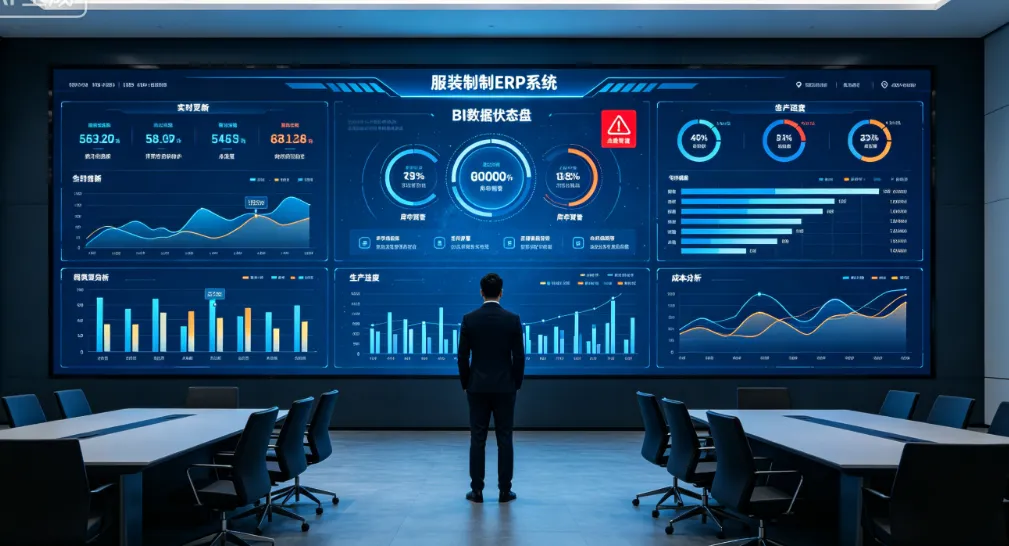
4、 Implementation steps: phased implementation to reduce online risks
The implementation of the clothing and garment ERP system is not a one-time success, and needs to be promoted in stages, gradually optimized, to reduce online risks and ensure deep integration between the system and business.
The first stage is project initiation (1-2 weeks). Establish a project team composed of multiple departments, clarify the responsibilities and project timeline of each member; Conduct training on ERP concepts, process standards, and operational norms to enhance employees' understanding and acceptance of the system.
The second stage is the preparation of basic data (2-4 weeks, the most time-consuming). This is the core prerequisite for the system to go live, which requires comprehensive sorting and input of basic data, including product files (model number, color code, size, picture, BOM, process), supplier and customer information, warehouse and location information, process and labor price standards, as well as initial inventory (raw materials, auxiliary materials, semi-finished products, finished products), to ensure accurate data and avoid deviations in subsequent system operation.
The third stage is system configuration and testing (2-3 weeks). According to the "Requirements Specification", complete the system module configuration, including process settings, permission allocation, report design, and customized printing templates; Conduct unit testing to verify whether the functions of each module meet the requirements; Conduct integration testing to ensure smooth data flow between modules (such as order → production → inventory → finance); Organize business personnel to conduct UAT user acceptance testing and verify through practical operation whether the system is suitable for actual business needs.
Phase four, pilot launch (2-4 weeks). Select 1-2 workshops or product lines as pilot projects, run the entire business process, collect problems that arise during the pilot process, and optimize them in a timely manner; Expand the scope of training to enable more employees to master the system operation methods and prepare for full deployment.
The fifth stage involves comprehensive launch and ongoing operation and maintenance. Promote the system throughout the company and gradually switch to the old management mode; Establish a normalized operation and maintenance mechanism, and do a good job in data monitoring, problem handling, and version iteration; Based on changes in enterprise business, continuously optimize system processes and functions to ensure that the system always adapts to the development needs of the enterprise.
5、 Key points for avoiding pitfalls and implementation suggestions: avoid detours and efficiently implement them
In the process of building an ERP system for clothing and garment manufacturing, five common misconceptions need to be avoided to ensure the effectiveness of the system implementation: firstly, do not simply copy the general ERP, but must focus on optimizing core functions such as style/color/code management, BOM management, process flow, and QR code reporting based on the characteristics of the garment industry; The second is to attach importance to the accuracy of basic data, such as style number, color code, size, etc BOM、 Once there is an error in initial inventory and other data, it can lead to confusion throughout the entire system operation process; The third is to follow the principle of "core first, then periphery", first running the core process of order → production → inventory → cost, and then gradually launching peripheral functions such as e-commerce docking and BI analysis; Fourthly, attention should be paid to mobile devices and scanning functions. Many workshop workers are not skilled in computer operations, and scanning codes on mobile phones and PDAs can greatly improve system utilization and work efficiency; The fifth is to adhere to the integration of business and finance. If the cost accounting is not accurate, it will significantly reduce the value of the ERP system.
Based on the scale of the enterprise, provide targeted implementation suggestions: small factories (less than 50 people) can choose mature SaaS ERP (such as Jianpai, Kingdee Star), which can be launched in 1-3 months, with costs controlled at 50000 to 150000 yuan, and quickly achieve basic digital management; Medium sized factories (50-200 people) can choose industry-specific ERP+secondary development, which will be launched in 3-6 months at a cost of 150000 to 500000 yuan, balancing adaptability and cost-effectiveness; Large factories (with over 200 employees) can choose customized development or large-scale industry ERP (such as SAP Apparel), which can be completed and launched within 6-12 months at a cost of over 500000 yuan, meeting personalized and large-scale management needs.
Conclusion: The core of the digital transformation of the clothing industry is to achieve full chain process standardization, dataization, and collaboration through ERP systems. Building a clothing and garment ERP system that meets industry needs can not only solve pain points such as inventory chaos, unclear costs, and delivery delays, but also help enterprises improve production efficiency, control operating costs, optimize decision-making quality, and gain an advantage in fierce market competition. Enterprises need to combine their own scale and needs, scientifically plan and steadily implement, so that ERP systems can truly become the core support for digital transformation.